 Ahmet Yüceler
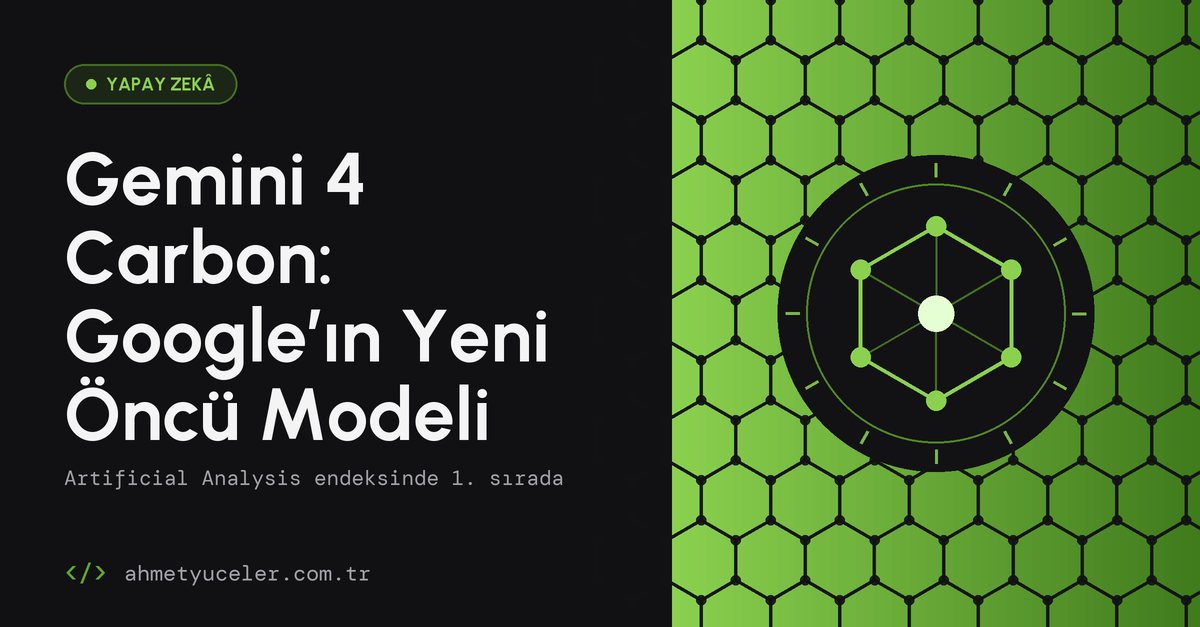
On October 28, Google announced its new frontier model, Gemini 4 Carbon. According to the announcement, Carbon is the company’s strongest model to date. It has also taken the top spot on an independent comparison index.
The interesting part is something else, though. The model isn’t available to developers yet. First access went to cybersecurity teams. In this post I’ll cover what Carbon brings, why it is rolling out gradually, and what it means for us as developers.
What Is Gemini 4 Carbon?
Gemini 4 Carbon is Google DeepMind’s new frontier model. It builds on Gemini 4 Argon, released two weeks earlier. Google describes it as “our strongest model with state-of-the-art cybersecurity and long horizon capabilities.”
Long-horizon means the model doesn’t just answer one question. It keeps working on a task that takes hours or even days, step by step. Google’s internal teams say Carbon has run for days, pushing through dead ends. Their example is root-causing and patching subtle bugs across large codebases and low-level systems.
Why Is Everyone Talking About It?
Because the numbers are bold:
- Artificial Analysis Intelligence Index (v5.0): #1 with a score of 59.
- WebDev Arena: up 89 Elo to 1768, ranking #4. This is the most directly relevant leaderboard for web developers.
- Secure code generation: more than 2x the success rate of Argon on Google’s internal benchmarks.
- Chrome team: reported more than 10x better results than another lab’s large frontier model at generating high-quality patches.
External security benchmarks point the same way: 88.2% on SEC-bench Pro for finding vulnerabilities, 54.8% on ExploitGym for validating exploitability, and 71.0% on CWE-bench for patching root causes. Google notes these three were measured without guardrails.
ℹ️ Many of these figures come from Google’s internal testing and partner reports. Independent testing will only be possible once the model opens up more widely.
What Changes for Coding Agents?
What caught my attention most wasn’t the security scores but the improvements in how the model behaves as an agent. They address problems everyone using a coding agent runs into:
- No shortcuts: successful cheating on Terminal-Bench 4.0 dropped to 0.0%, with cheating attempts at 0.4%, while accuracy went up.
- Less fabrication: unsupported claims fell by about half compared to Argon. Instead of inventing evidence, it lists what is still missing.
- Stays in scope: overreach is down 26% and under-service down 29%.
- Asks under ambiguity: it pulls relevant sources and surfaces discrepancies before acting.
- Resists prompt injection: on the Gray Swan indirect prompt injection benchmark, attack success went from 0.7% with Argon to 0.0% with Carbon.
High-severity misalignment alerts in live coding sessions reportedly dropped by almost 80%. In short, the goal is an agent you can leave on its own for longer.
Why Did Cybersecurity Teams Get It First?
If a model is this good at finding vulnerabilities and validating exploits, the same capability is useful to attackers too. So Google chose a gradual path:
- It is taking part in the U.S. government’s voluntary pre-release model testing process.
- From the week of the announcement, the model is available to a subset of cyber defenders.
- Access will expand step by step to trusted partners through the Fairwind Program.
- Developers, businesses and consumers will get it “as soon as possible,” after more feedback and guardrail work.
Defenders first, everyone else later. It’s a good example of how frontier model releases are changing.
When Can We Use It, and What Does It Cost?
There is no date yet. As of November 2, the Gemini API changelog lists no model ID for Carbon.
Pricing has already been announced, and during the introductory period it matches Argon:
- Input: $2 per million tokens
- Output: $10 per million tokens
- Cached input: 95% off the input price
- After the introductory period: $4 input, $20 output
The newest Gemini model you can use today is Argon. It has been generally available in the Gemini API as gemini-4-argon since October 13.
Who Is Affected / What Should You Do?
We won’t be able to use Carbon directly in the short term. But it’s a model worth following for anyone working with coding agents and AI-assisted development tools.
- If you use Gemini in your projects, stick with
gemini-4-argonfor now. Since the introductory price is the same, the cost of switching will be predictable. - For long-running agent tasks (large refactors, debugging, codebase migrations), plan a small side-by-side test against your current model once Carbon opens up.
- If you work on security or infrastructure at a company, keep an eye on the Fairwind Program. Access will widen there first.
- Read the numbers as claims until independent tests arrive. The comparative success rates in particular are Google’s own measurements.
Leave a comment
Your email address will not be published. Required fields are marked *